Who Created OpenClaw? The Story of Peter Steinberger and OpenClaw
If you’ve ever looked up OpenClaw, you’ve probably seen the name Peter Steinberger – the developer credited with creating it. But who is he, why did he build OpenClaw, and how did a personal project become one of the most talked-about open-source AI tools in 2026?
This article tells the story behind OpenClaw: where it came from, what problem it was built to solve, and how the community grew around it.
Key takeaways:
- Peter Steinberger, founder of PSPDFKit (now Nutrient), created OpenClaw as a personal AI assistant project focused on ownership, flexibility, and automation.
- OpenClaw was designed to close the “anticipation gap” by bringing AI directly into apps like Telegram and Signal instead of relying on browser chatbots.
- Unlike many AI tools, OpenClaw supports multiple models including Claude, GPT, DeepSeek,… while allowing users to run the system locally for better data control.
- The project grew rapidly thanks to its open-source approach, plugin-based Skills ecosystem, and strong developer community contributions worldwide.
- By 2026, OpenClaw had evolved from a developer experiment into a mainstream AI platform with global communities, and hundreds of thousands of GitHub stars.
Who is Peter Steinberger?
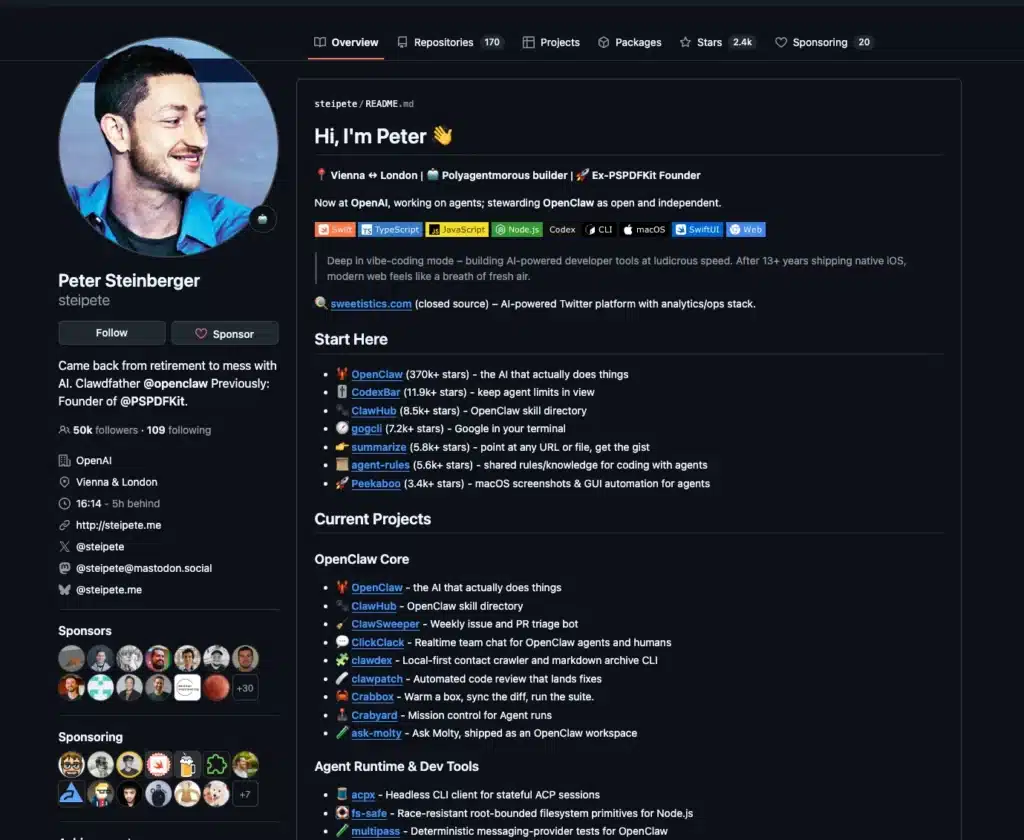
Peter Steinberger is an Austrian software engineer, entrepreneur, and open-source developer. He is best known for two major contributions to the tech world: founding PSPDFKit in 2010 – a company building PDF frameworks for mobile and web applications – and creating OpenClaw in late 2025, which became the fastest-growing open-source project in GitHub history.
Within the developer world, Steinberger has a reputation for:
- Shipping high-quality, production-ready software: PSPDFKit became the industry standard for PDF handling on iOS and beyond
- Open communication: he’s been outspoken on developer topics through blog posts, conference talks, and social media
- A strong engineering culture: PSPDFKit grew from a solo project to a company with hundreds of employees while maintaining a reputation for code quality
His GitHub profile reflects years of open-source contributions across different projects, and OpenClaw is his most ambitious public project to date.
Why did Peter Steinberger build OpenClaw?
After 13 years of building PSPDFKit into a quiet backbone of the software industry, Steinberger exited the company and, by his own admission, felt a little lost.
The return to coding came through AI and it started with a simple frustration: every AI tool he tried just sat there waiting to be asked something. He wanted the opposite.
He began experimenting in April 2025, initially under the name Clawdbot, building an agent that could run locally on a user’s machine, read their screen, connect to their calendar and emails, and act without being prompted, closing what he called the “anticipation gap” between reactive chatbots and a true digital employee.
1. Closing the anticipation gap.
He leaned into “vibe coding,” using LLMs to write and ship code at a pace that would have been unthinkable just years earlier, pushing hundreds of updates driven by raw community feedback.
2. AI should come to you, not the other way around.
By integrating with everyday messaging apps like Signal and Telegram, OpenClaw let users interact with AI directly where they already were, no extra tab, no context switching.
3. You shouldn’t be locked into one model.
OpenClaw was model-agnostic by design, letting users tap into Claude, GPT, DeepSeek,… or switch between them depending on the task.
4. Data ownership matters.
By running locally on a user’s machine, OpenClaw ensured the “brain” – the coordination layer – stayed where the user wanted it, not on someone else’s server.
What started as a personal experiment to rediscover the joy of building quickly became something much larger. OpenClaw went viral, amassing 370K+ of GitHub stars in just 7 months after release and spawning an entire AI-agent ecosystem, including Moltbook, a social space where autonomous agents could interact.
By February 2026, after a public recruitment battle between Meta and OpenAI, Steinberger announced he was joining OpenAI, leaving OpenClaw in the hands of an open-source nonprofit foundation to ensure it stayed true to its roots.
From Personal Tool to Open-source Project
OpenClaw started as a personal tool, something Steinberger built to scratch his own itch. The first version was a lightweight gateway that connected Telegram to an AI model, letting him ask questions and get answers without switching apps.
When he shared it publicly on GitHub, the response from the developer community was faster than expected. Other developers recognized the same frustrations, started contributing improvements, and the project began to grow on its own momentum.
A few things accelerated growth:
- Open-source from day one: the decision to release the code publicly meant anyone could inspect, fork, or contribute to it. This built trust quickly.
- Multi-model support early on: when other tools locked users into one AI provider, OpenClaw let you plug in whichever model you preferred. This made it useful to a wider range of developers.
- Skills system: the plugin architecture (now the Skills marketplace on ClawHub.ai) let community members extend OpenClaw for specific use cases without touching the core codebase.
- Community channels: early adopters built Telegram groups, Discord servers, and local communities that helped new users get started and share workflows.
OpenClaw in 2025–2026: From Developer Tool to Mainstream
The original audience for OpenClaw was developers and technically-minded users. But over 2025 and into 2026, something shifted.
As AI became more mainstream, non-technical users started looking for ways to use it without opening yet another app. OpenClaw’s core proposition, which is AI through the messaging apps you already use, turned out to resonate far beyond the developer world.
The addition of cloud hosting options (making it possible to use OpenClaw without any installation) lowered the barrier to entry significantly. Products like TryOpenClaw.io brought the power of OpenClaw to users who would never touch a terminal.
By May 2026:
- OpenClaw has accumulated 370K+ of GitHub stars and contributors from dozens of countries
- The Skills marketplace on ClawHub.ai hosts community-built add-ons for everything from Telegram group management to SEO writing
- Users span individuals, freelancers, small businesses, and enterprise teams
- Localized communities have grown in Vietnam, Japan, Germany, Brazil, and beyond
The Future of Peter and OpenClaw
Steinberger’s next mission is simple to state, hard to execute: build an agent that “even my mum can use.” Joining OpenAI wasn’t a pivot away from OpenClaw, it was the fastest path to get there. As he put it, “I’m a builder at heart. I did the whole creating-a-company game already.” What he wanted was access to frontier research and the people pushing it, not another 13 years running an org.
OpenClaw itself is still a home for “thinkers, hackers, and people that want a way to own their data.” The community he calls “magical” stays intact. The vision stays open.
Frequently Asked Questions
These are the questions people ask most about OpenClaw and Peter Steinberger.
Who created OpenClaw?
OpenClaw was created by Peter Steinberger, an Austrian software developer also known for founding PSPDFKit (now Nutrient). He built the initial version as a personal tool and released it as open source on GitHub.
Is OpenClaw still maintained by Peter Steinberger?
Yes, Steinberger remains involved in the project. OpenClaw also has a broader community of contributors, meaning it doesn’t rely solely on any one person.
Why is OpenClaw open source?
Steinberger’s philosophy centers on user ownership and transparency. Open-source means anyone can inspect the code, run it themselves, and contribute improvements, giving users genuine control over the software they rely on.
When was OpenClaw created?
OpenClaw began as a personal project before being publicly released on GitHub. It has grown significantly since then, with adoption expanding in 2025–2026 as AI tools became mainstream.
Is OpenClaw connected to PSPDFKit / Nutrient?
No. OpenClaw is a separate, independent open-source project. It is not a product of Nutrient. The connection is simply that Peter Steinberger founded both.
Related Posts

Bộ prompt viết code bằng trợ lý AI hiệu quả cho lập trình viên

Cách chạy workflow tự động hóa 24/7 trên cloud cho doanh nghiệp