Yes — in a managed private-cloud setup like TryOpenClaw, your data stays in your own private instance. That means the agent works inside an isolated environment instead of a shared runtime, so you are not relying on a generic public setup to keep projects separate. For a developer or team using OpenClaw today, the real question is not whether the agent can process data, but where that data lives and who can reach it.
- Each agent runs in its own isolated instance, so workflows are separated by design.
- Data stays within that private environment unless your workflow sends it elsewhere.
- OpenClaw access, AI tokens, and storage behavior depend on the service setup you use.
- Privacy can still be affected by external APIs, shared files, or integrations you connect.
- The safest check is to confirm what the platform stores, what leaves the instance, and what you control.
Yes: each agent runs in its own private environment
The core privacy model is simple: each agent runs in a separate environment, so your work is not mixed with someone else’s. In TryOpenClaw, that private instance is created automatically on private cloud infrastructure, which is the key difference from a setup where you self-host, share a server, or reuse one runtime for many users. If you are asking whether your project files, prompts, and outputs are exposed to other customers, the answer is no under this model.
This matters because OpenClaw agents often touch sensitive operational data: CSVs, spreadsheets, internal research, content drafts, Telegram or Discord workflows, and automation steps that may include business context. When those tasks run in a private instance, the environment boundary is what keeps one agent’s state from becoming another agent’s problem. It also reduces the usual self-hosting risks like misconfigured ports, broken dependencies, or updates that destabilize the agent and force you to rebuild the stack.
What stays isolated and what that means for your data

Isolation usually means the agent’s files, runtime state, and workflow context remain inside that instance unless you explicitly move them out. For most users, that includes uploaded documents, generated outputs, temporary working files, and the data the agent needs to complete a task. It does not mean every possible piece of information is invisible by default; it means the platform is designed so the instance boundary is the first line of separation.
That distinction is important. If you connect the agent to an external source, export a result, or send a request to another service, the data can leave the private environment because you asked it to. Privacy is therefore a combination of platform isolation and your own workflow design. The instance can be private, while the tools you connect to may have their own logging, retention, or access rules.
How TryOpenClaws handles access, storage, and AI tokens
TryOpenClaw is built as a managed SaaS layer on top of OpenClaw, so you get a ready instance instead of assembling one from scratch. That matters for privacy because the service is structured around a private environment per agent, with no need to clone a repo or manually wire the runtime before you can start. The business also states that data is not shared with other systems, which aligns with the private-instance model described above.
For access, the practical point is that you log in and work inside the instance you were given. For storage, you should think in terms of what the agent needs to keep available during its work, not as a shared pool of customer data. And for AI tokens, the service notes that token AI is included on the stated plans and that API key is not required in those plans. That reduces one common privacy concern: you do not have to expose your own external API credentials just to begin using the workflow.
When privacy can still depend on how you use the agent
Private infrastructure does not remove every privacy risk. If your agent is instructed to send content to third-party services, use a public webhook, pull data from a shared repository, or publish outputs into a channel you do not control, the privacy boundary changes with that action. The same is true if you paste confidential data into a prompt and then intentionally ask the agent to transform or distribute it.
In practice, privacy depends on three things: the instance boundary, the integrations you connect, and the data handling choices in your workflow. A private OpenClaw setup can keep the environment isolated, but it cannot override the behavior of another service you call. So the right way to evaluate privacy is to ask where the data starts, where it is processed, and where it is allowed to go next.
What to check before you trust a private OpenClaw setup
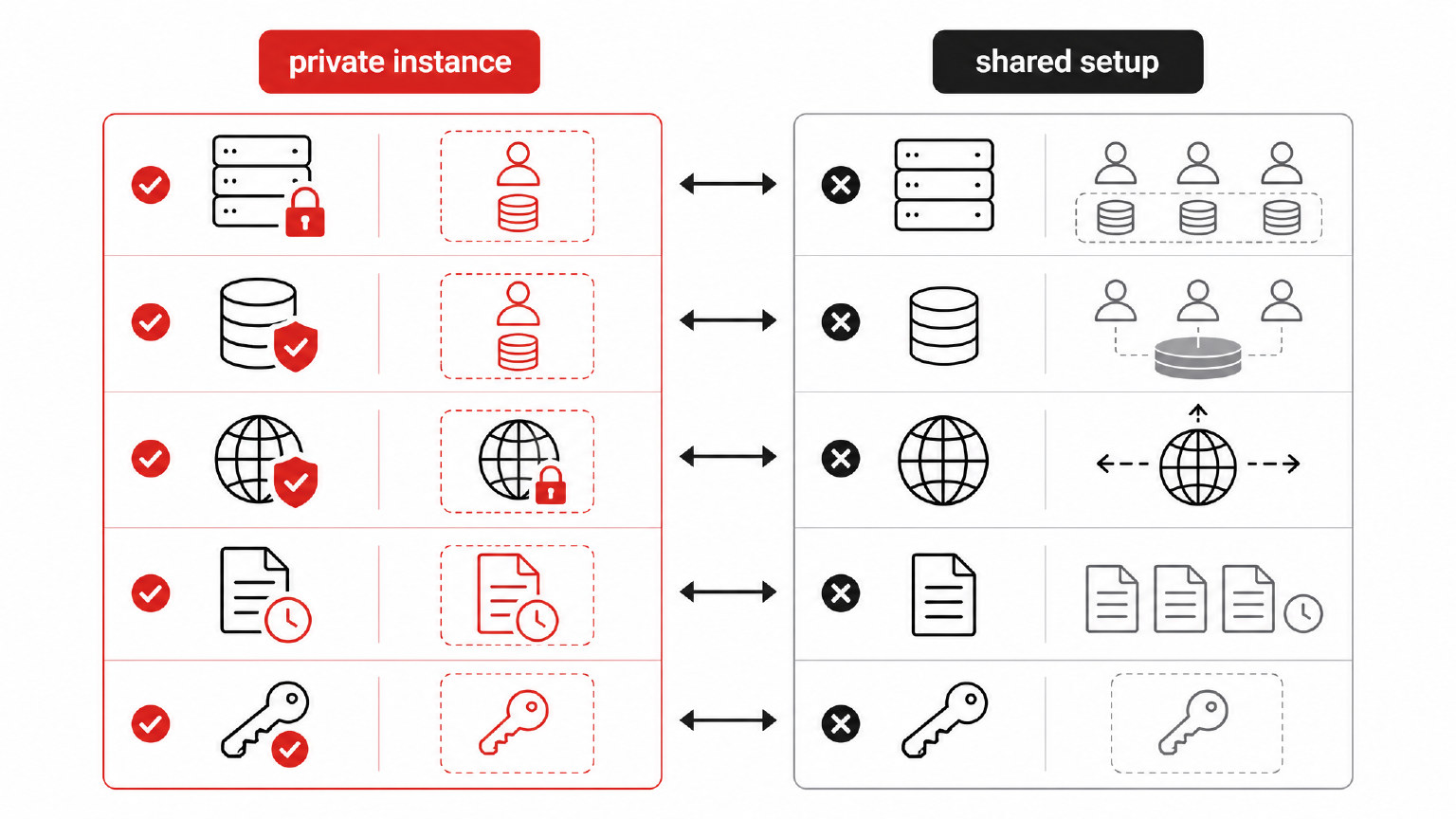
Before you rely on any private OpenClaw setup, check whether each agent truly has its own isolated instance, whether data is separated from other users, and whether the service explains when data leaves the environment. You should also confirm what is stored, how long it is retained, and whether the platform needs your own API key or uses included tokens. Those details tell you much more than a generic privacy claim.
It is also worth checking operational safeguards. A managed service should make it clear whether the instance can recover after failure, whether updates are handled centrally, and whether the setup is meant to reduce the burden of self-hosting without exposing your work to a shared runtime. If you are evaluating TryOpenClaw specifically, the promise is straightforward: quick launch, private instance, and a setup designed to keep your agent work separated from everyone else’s.
FAQ: common privacy questions about TryOpenClaw
Does OpenClaw access my data in TryOpenClaw?
It accesses the data needed to run inside your instance, but the setup is designed so that data stays in that private environment rather than in a shared workspace.
When does data leave the private instance?
Data leaves when your workflow sends it out through an integration, export, webhook, or external service that you connect.
Do I need my own API key to use the included plans?
No. The stated plans include token AI and do not require an API key for the use cases described.
Is this privacy model the same as self-hosting?
Not exactly. Self-hosting gives you full infrastructure control, while a managed private-cloud setup gives you isolation without the maintenance burden.
When does this privacy setup not apply?
It does not apply once you intentionally share data outside the instance or connect the agent to services with their own retention and access rules.
So, if you are asking whether your data is private in OpenClaw, the practical answer is yes when you use a managed private instance like TryOpenClaw. Your agent runs in its own environment, your data is not meant to be shared with other users, and you only lose that boundary when your own workflow sends information elsewhere. If privacy is a priority, the next step is to verify the instance model, the storage rules, and the integrations you plan to use.
Related Posts
OpenClaw browser relay
Install OpenClaw